OEM & ODM Headwear & Bags · Linyi, Shandong, China
High-Quality Leading Beach Straw Bags Manufacturer & Supplier
A factory-direct partner for importers, brands and retailers — engineering beach straw bags, straw hats and woven accessories with 15+ years of hand-weaving expertise, 50–100 pcs minimums and an 8-hour response guarantee.
15+Years of manufacturing
60+Countries served
25+Global distributors
8 hrsResponse & action
Executive Summary
Why a Beach Straw Bag Specialist Beats a General Trading Desk
Shandong Lige Import & Export Co., Ltd. has focused on straw hats, paper hats, straw bags and paper bags for more than 15 years from Linyi City, Shandong Province — within easy reach of Qingdao Port, one of China's major container gateways. For buyers, that means one reliable source for beach straw bags, floppy sun hats, bucket hats, visors and children's sets, produced under one roof.
This guide is written for sourcing managers, own-brand owners and retail buyers who need to compare suppliers on more than price. It covers the practical realities of beach bag and straw hat production in 2025 — fiber selection, material roadmaps, supply-chain resilience, market dynamics, localization support and compliance — with the same standards we apply when advising our own customers.
Category depth
One-Stop Woven Accessories
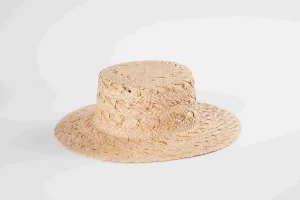
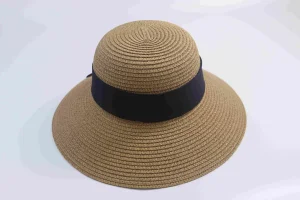
Beach straw bags, floppy hats, bucket hats, boater hats, Panama styles, visors, children's sets and paper bags developed, sampled and packed in the same facility — simplifying your seasonal program.
In-house line
Raw Fiber to Finished Bag
Material sorting, weaving, blocking, finishing, trimming and final inspection are all performed internally — stable quality and pricing without middleman margins.
Service level
Low MOQ & Fast Replies
Start with 50–100 pieces per design. Our team responds and takes action within 8 hours on questions, sampling, order follow-up and after-sales.
Featured Catalog
Beach Straw Bags & Woven Headwear Best Sellers
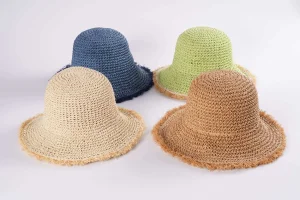
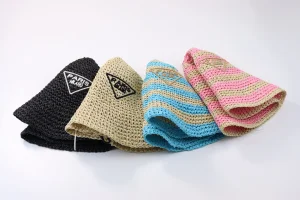
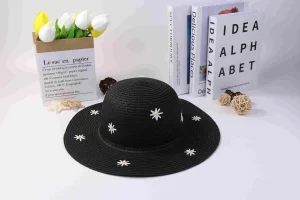
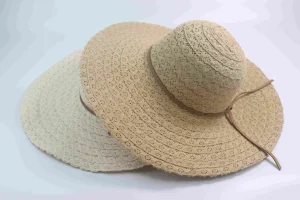
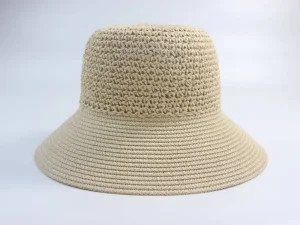
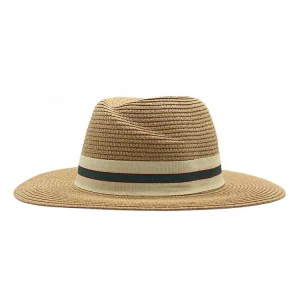
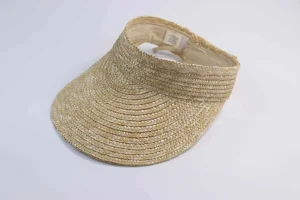
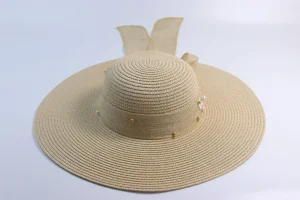
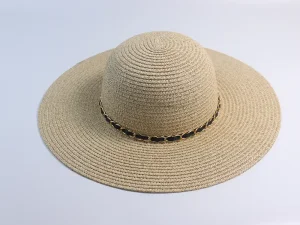
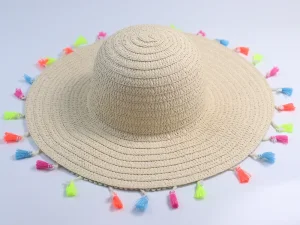
Styles proven across North American, Australian and European retail seasons. Every item can be produced in raffia, paper straw or natural grass straw with custom bands, labels and colorways.
Where Beach Straw Bags Win: Localized Application Scenarios
Beach straw bags are not a single product — they are a platform. The same construction logic adapts to wildly different retail contexts. Here is how buyers in our main export markets deploy them.
North America
Resort & Coastal Retail
Florida, California and Hawaii resort boutiques order seasonal capsule collections with bold dyed raffia, oversized totes and coordinated floppy hats. Buyers prioritize packability and shape recovery after shipping and in store display.
Western Europe
Multi-Brand & Department Stores
French, German and Dutch retailers demand tighter color discipline, precise size grading and consistent weave density. Private-label baskets, half-moon bags and structured totes lead the assortment.
Australia & NZ
Outdoor & UV-First Programs
Wide brims, sun-visor coordinated sets and UPF-aware constructions dominate. Seasonal timing runs counter to the Northern Hemisphere, which requires flexible production scheduling from suppliers.
Japan & Korea
Craft & Detail-Driven Buyers
Fine braid counts, hand-finished handles and modular bags that fit compact urban usage. Buyers reward suppliers who can control weave consistency at small tolerances.
Mexico & LATAM
Tourism & Souvenir Programs
High-volume, high-color, durable bags for coastal hotel shops and gift stores. Cost-optimized paper straw and braided grass bags with fast replenishment cycles.
Brand Owners
Lifestyle & DTC Collections
Small-batch private label with woven labels, hang tags and custom trims. The 50–100 pcs MOQ lets emerging brands test SKUs before committing to full containers.
Technology Roadmap
From Natural Fiber to Smart Woven Manufacturing
Beach bag manufacturing is quietly modernizing. The roadmap below summarizes the four phases we track and invest against — from traditional hand-weaving to digital and traceable production.
Phase 1 · Artisanal Baseline
Hand-weaving and manual blocking dominate. Quality depends entirely on weaver skill and QC discipline — the historical strength of Chinese straw clusters.
Phase 2 · Semi-Automation
Mechanical braiding and standardized blocking jigs stabilize weave density, reduce defects and shorten sampling cycles without losing hand-finished character.
Phase 3 · Digital Traceability
Batch-level material tracking, digital QC records and QR-linked production logs support stricter compliance, recycling claims and retail audits.
Phase 4 · Smart & Sustainable
Low-impact dyes, certified recycled paper straw and water-efficient finishing, coordinated with automated inspection vision systems for consistent output.
Supply Chain
China Factory Resilience & Efficiency
The "why China" conversation is over. The real question in 2025 is how a sourcing team can secure resilient capacity, dependable lead times and auditable quality — without sacrificing cost competitiveness.
Structural Advantages of a Shandong Factory
Linyi and the surrounding Shandong cluster is one of the world's most concentrated centers of straw and paper-straw production. That density creates real advantages for buyers:
Integrated fiber access. Raffia, paper straw and natural grass are available through mature local suppliers, reducing lead time and cost volatility.
Skilled labor depth. Weaver training pipelines are mature, allowing consistent output during peak summer shipping windows.
Logistics proximity. Qingdao Port supports both FCL and LCL exports, with reliable rail and road links into the terminal.
One-roof control. Sorting, weaving, blocking, finishing and QC reduce the handoff risk that plagues multi-vendor sourcing models.
How We Measure Efficiency
Buyers compare suppliers on more than price per piece. The chart below reflects our own internal program metrics, which we share with new customers during onboarding.
Sampling turnaround3–7 days
Bulk production (small MOQ)15–25 days
Bulk production (container)25–40 days
Order-change response8 hours
Backup fiber inventories
Dual-source raffia and paper straw allocations protect production during upstream shortages.
Compressed cycles
Sampling in under a week and small-lot runs let buyers test fast and replenish seasonally.
Flexible shipping plans
FCL, LCL and air-express options adapt to launch timing and destination market conditions.
Documented QC
Final inspections on shape, stitch, size and trims, with photo evidence shared before export.
Global Market Dynamics
Where the Beach Straw Bag Category Is Heading
Worldwide, natural-fiber accessories are benefiting from two reinforcing trends: a structural shift toward sustainable materials, and a consumer preference for artisan and "quiet luxury" aesthetics. Both favor suppliers who can deliver craft quality at commercial scale.
Sustainability
Natural Fibers vs. Synthetics
Retailers increasingly flag petroleum-based polypropylene in bag lines. Natural raffia and paper straw give a defensible sustainability story without redesigning the category.
Design
Quiet Luxury Aesthetic
Premium buyers lean toward tonal, undyed or subtly dyed bags with craft-heavy finishing — a shift that rewards factories with strong finishing teams.
Channel
Direct-to-Consumer Growth
Smaller MOQs are now a competitive necessity as DTC brands iterate on capsules, bundles and seasonal drops.
Compliance
Material Transparency
EU and North American buyers are pushing for traceability down to material batches. Digital documentation is becoming standard, not optional.
Industrial Context: A Mature but Consolidating Category
The beach straw bag supply base has historically been fragmented, with thousands of small workshops serving regional markets. Over the past decade, demand from importers for predictable quality, auditable compliance and dependable lead times has driven consolidation toward larger, vertically integrated factories. Buyers increasingly prefer to consolidate seasonal programs with a single supplier who handles straw bags, straw hats and related accessories — reducing both sourcing overhead and quality variance.
Buyer's Material Guide
Choosing the Right Fiber for Beach Bags & Hats
Fiber determines hand-feel, shape retention, unit cost and how a bag survives shipping. This is the same guidance our product team gives buyers before sampling.
Raffia
A natural palm-leaf fiber traditionally sourced from Madagascar. Its natural resins make it soft, flexible and highly dye-receptive — brims and bag bodies recover their shape after packing.
Twisted paper yarn woven or braided into a lightweight, uniform fabric. Delivers clean, consistent colors and a competitive unit cost for volume programs.
Best for: fedoras, Panama-style hats, seasonal and promotional retail.
Natural Grass Straw
Braided natural stems with inherent stiffness, producing crisp silhouettes and an authentic artisanal look that supports premium price points.
Best for: boater hats, western hats, structured totes.
Fabric & Knit
Cotton, polyester and knitted constructions extend the assortment beyond summer into children's and cold-weather programs.
Best for: visors, winter hats, children's hats, toy hats.
Localization Support & Compliance
Built for Global Buyers, Local Expectations
Selling a bag into Germany is not the same as selling it into Florida. Our localization and compliance support is structured so that labeling, testing and documentation are handled before the container leaves Qingdao.
Labelling
Brand & Market Labeling
Woven labels, hang tags, care labels, fiber content claims and origin marking configured to the destination market and your brand style guide.
Testing
Material & Safety Testing
Support for common buyer-requested testing, including fiber composition verification, color fastness, and parameters relevant to children's items.
Documentation
Export Paperwork
Commercial invoices, packing lists, certificates of origin and product spec sheets prepared in line with importer requirements.
Packaging
Retail-Ready Packaging
Polybag, tissue wrap, hang tag placement, barcode labeling and carton marking tailored to your distribution center or retail shelf.
Language
Bilingual Communication
English-first communication with a single point of contact per account, tracing each order from sampling through export and after-sales.
Sustainability
Material Transparency
Disclosure of fiber type and sourcing pathway to support your own sustainability claims and buyer-side audit requests.
Experience You Can Audit
Why Importers Keep Their Seasonal Programs With Us
Our customers are importers, wholesalers, brand owners and retailers in the United States, Canada, Australia, Mexico, Western Europe and Japan. They stay with us for four reasons: predictable quality, realistic pricing, dependable lead times and a team that answers within 8 hours.
Experienced Team
A production manager with 20 years of experience and a QC manager with 15 years; the team averages 5+ years of tenure — reflected in consistent weaves and accurate sizing.
Direct Factory
Raw material sorting, weaving, blocking, finishing and final inspection under one roof — stable quality and pricing without middleman margins.
Low MOQ
50–100 pcs per design so private-label launches can be tested without overstock risk, then scaled into repeat programs.
8-Hour Response
Action within 8 hours on product questions, sampling, order follow-up and after-sales — with a single dedicated contact for your account.
More From the Catalog
Extend Your Program With Customizable Woven Styles
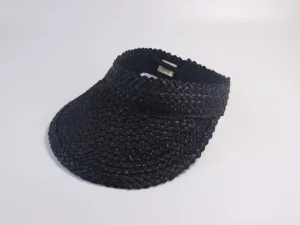
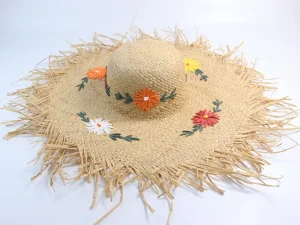
Every silhouette can be adapted in colorway, brim width, strap type and branding. Use the reference set below to shortlist candidates for your next sampling round.
From first brief to container loading, every stage is documented so buyers know exactly what is happening and when.
Step 01
Share Your Brief
Style, material, size, color, branding and target quantity. Reference samples and mood boards are welcome.
Step 02
Design & Sampling
Our designers recommend materials, weave density and finishing, then develop samples for approval.
Step 03
Approval
Confirm samples, labels, packaging and the delivery schedule before production is scheduled.
Step 04
Production
Material sorting, weaving, blocking and finishing are carried out in-house to our QC standards.
Step 05
Quality Inspection
Final inspection of shape, stitching, dimensions and trims, with photo evidence shared with you before packing.
Step 06
Export Shipping
FCL or LCL sea freight via Qingdao Port, with air-express options for samples and urgent small orders.
Buyer FAQ
Questions Straw Bag & Hat Buyers Ask Us Most
Straight answers on MOQ, customization, shipping, materials and service. Need more detail? Our team replies within 8 hours.
What is the minimum order quantity for custom beach straw bags and hats?
Our starting quantity for small orders is 50 to 100 pieces per design, depending on material and craftsmanship. This lets boutiques, emerging brands and importers test new styles before scaling up into container programs.
Can you produce private-label bags and hats with our own logo?
Yes. OEM and ODM production is our core business. We customize shape, material, color, size and trims, and can add branding elements such as woven labels, patches and hang tags. Our in-house designers can also develop new styles from your mood board or reference samples.
Where is your factory and how are orders shipped?
We are located in Linyi City, Shandong Province, China, close to Qingdao Port. Bulk orders are typically exported by sea as FCL or LCL shipments, while samples and urgent small orders can be sent by air or express courier.
Which markets do you export bags and hats to?
Most of our products are exported to the United States, Canada, Australia, Mexico, Western Europe and Japan. We serve customers in more than 60 countries and work with over 25 global distributors.
How quickly does your team respond to buyer requests?
We respond and take action within 8 hours, covering product questions, sampling, order follow-up and after-sales service.
What materials do you recommend for a beach straw bag program?
Raffia delivers the softest hand-feel and strongest dye response, making it ideal for premium resort lines. Paper straw offers clean color consistency at a competitive unit cost for volume programs. Natural grass straw suits structured totes and western-inspired carry. We will recommend a fiber mix based on your destination market, price point and packaging plan.
Do you support children's straw hats and coordinated bag sets?
Yes. In addition to adult straw bags and hats, we manufacture children's straw hats, toy hats and coordinated kids' hat-and-bag sets — a growing category in resort retail and gift channels.
What do you make besides beach straw bags?
Alongside straw bags, we manufacture paper hats, straw bags, paper bags, straw hats, lifeguard hats, sun visors, winter hats and other bags — letting you consolidate seasonal programs with a single supplier.
Can you support compliance documentation for EU and North American retailers?
Yes. We prepare commercial invoices, packing lists, certificates of origin and product spec sheets, and can support common buyer-requested testing for fiber composition, color fastness and parameters relevant to children's items. Specific compliance requirements are confirmed at the sampling stage so there are no surprises at export.
Start a Program
Let's Build Your Next Beach Straw Bag Collection
Send your style references, target quantity and destination market. Our team replies within 8 hours with material suggestions, a sampling plan and a production timeline.